End of summer doesn’t mean the end of seeing things
There is sometimes a feeling that once summer starts to disappear, so does much of the wildlife and colour that comes with it.
The butterflies become less frequent, the flowers start to fade, the days get shorter and suddenly everything feels a little quieter.
But perhaps we just need to look a little differently.
Looking back over the last nine days of my Daily Photo Challenge, I’ve realised just how much variety I’ve actually found.
And I haven’t had to travel anywhere special to find it. It has either been while working, on home walks or going to Clumber Park.
Still finding butterflies
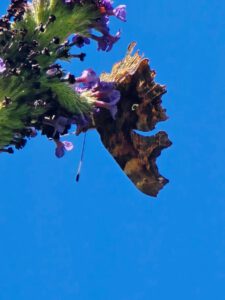
One of the photos was this rather lovely Comma butterfly.
It was one of those moments where you spot something moving amongst the leaves and, before you know it, you’re trying to get your phone into position without disturbing it.
I loved getting this one from below, as it is great for seeing the ‘comma’ on the underside of its wing too.
Butterflies may not be quite as numerous as they were a few weeks ago, but they’re certainly still around.
And then there was another little surprise.
A Box moth.
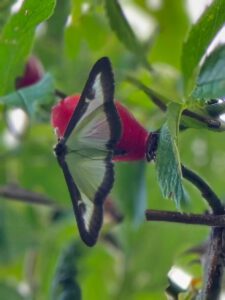
Not necessarily something that would make everyone’s list of spectacular wildlife, but that’s exactly why I enjoy doing this challenge.
This one was a real challenge too, as it landed around 9 feet or so up in a bush.
You never quite know what you’re going to find.
Sometimes the interesting things are the ones you weren’t actually looking for.
The flowers are changing too
The flowers are starting to tell us that the seasons are moving on.
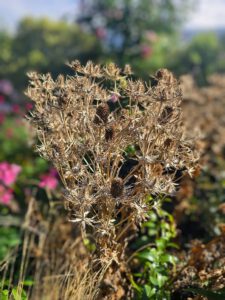
The Eryngium seedheads were a perfect example.
They aren’t the bright flowers that might have caught my eye earlier in the summer, but left to go to seed, they have a completely different beauty.
It is also really important to leave these old flowerheads for birds to feed on over winter and for insects to shelter in through the colder months.
It’s another reminder that nature doesn’t simply stop being interesting when something finishes flowering.
It changes.
And sometimes those changes give us something completely different to photograph.
Thinking about wildlife beyond the obvious
Then there was the hedgehog-friendly gravel board I spotted when I was caring for one of our lawns last week.
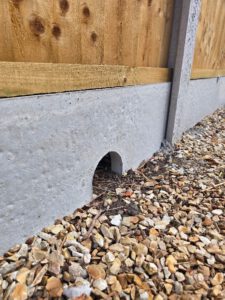
At first glance, perhaps not the most exciting subject for a nature photography challenge.
But look a little closer.
Someone has deliberately created a small opening at the bottom of a fence so that wildlife can move through.
A tiny hole, but potentially a very important one.
It’s one of those photographs that isn’t really about the photograph at all.
It’s about the idea behind it.
Sometimes helping wildlife doesn’t have to mean building elaborate habitats or doing anything complicated.
Sometimes it’s simply remembering that the creatures sharing our gardens need a way through.
And then there was a Jay
I’ve been seeing Jays regularly enough lately that perhaps I should stop being surprised when one appears.
But of course, getting a photo of one is easier said than done.
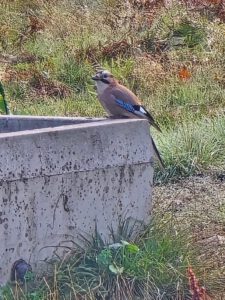
They’re such striking birds, especially when you catch that flash of blue on the wing.
This one was sitting quite happily on the edge of a cattle trough, happily drinking away.
Rolo was less than impressed, as he was waiting to jump in there for his morning dip.
Again, no wildlife reserve or exotic location required.
Just being out and actually looking.
Something a little more unusual
Then came the Pale Tussock moth caterpillar.
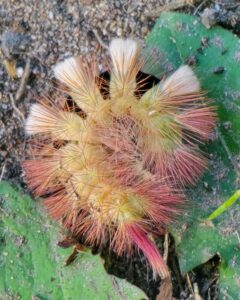
Now this was definitely one of those “wow” moments, as this caterpillar had curled up like this after I rescued it while it was crossing the road.
I’ve always liked finding the things that don’t immediately look familiar.
You stop.
You look closer.
You take a photograph.
And then, quite often, you end up finding out what you’ve actually photographed.
I think that’s one of the things this challenge has taught me over the years. Photography isn’t just about recording what you see; it can make you curious about what you’ve seen.
Mushrooms are joining the party
As summer gives way to autumn, fungi start becoming much more noticeable too.
This Parasol Mushroom certainly stood out for us.
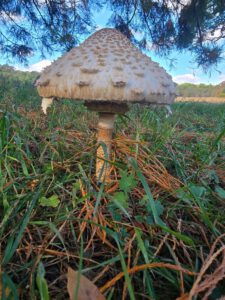
And this is probably where the seasonal change becomes most obvious.
The landscape is beginning to look different.
There is more decay, more seedheads, more fungi and more of those subtle changes happening all around us.
But that doesn’t mean nature has gone quiet.
Far from it.
Sometimes the photo is simply the place
And then there are days when I don’t find something particularly unusual at all.
Instead, I find somewhere that just makes me stop.
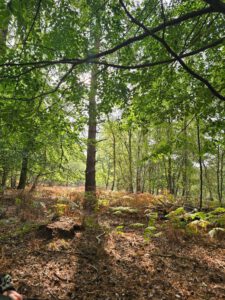
This woodland scene was one of those photographs.
No rare species.
No macro close-up.
No clever angle.
Just sunlight coming through the trees, the ferns on the woodland floor and that feeling you get when you stand somewhere peaceful and think, this is rather nice.
Sometimes that’s enough.
And then there are the spiders
If there is one thing that autumn definitely seems to bring in abundance, it’s spiders’ webs.
Especially when the sunlight catches them.
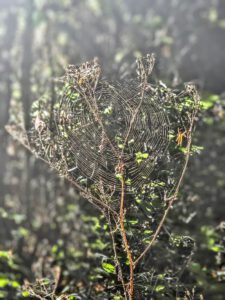
Suddenly something that was almost invisible becomes impossible to miss.
The web catches the light and you realise just how much detail was there all along.
And perhaps that’s actually the theme running through all nine of these photographs.
Look a little closer.
Because the end of summer doesn’t mean the end of seeing things.
It just means the things we’re seeing are changing.
The butterflies may be fewer.
The flowers may be going to seed.
The leaves are beginning to change.
Fungi are appearing.
Spiders are busy.
Birds are still around.
And there are all sorts of tiny things happening that we can easily walk straight past.
After more than 1,550 days of taking a photo every day, I think that’s one of the biggest lessons the challenge has given me.
You don’t need to travel miles to find something worth photographing.
And I always say that every photo is taken on my phone. No special equipment is needed to take these photos.
You don’t even necessarily need to go looking for wildlife.
Just go for a walk, slow down a little and actually look.
You might be surprised by what you find.
And if the last nine days are anything to go by, autumn could be just as interesting as summer.
Maybe even more so.